
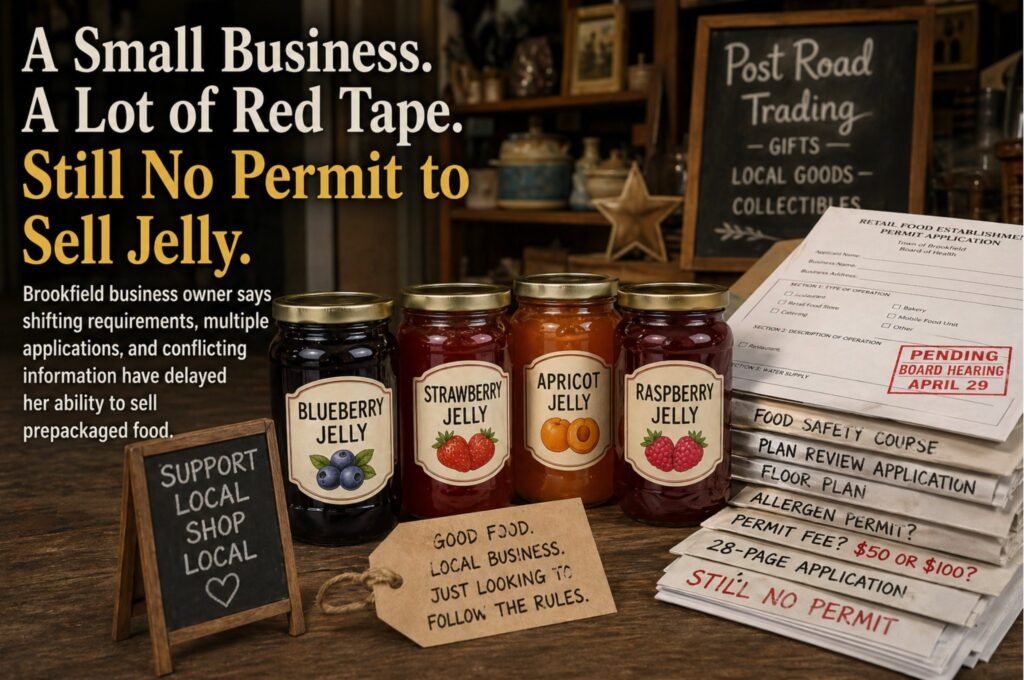
Brookfield Business Faces Lengthy Process to Sell Prepackaged Food
BROOKFIELD, MA — What began as a simple plan to offer food products at a local retail shop has turned into a complicated, months-long permitting process involving multiple applications, shifting requirements, and repeated requests for clarification, according to the owner of Post Road Trading.
Bonnie Toomey, the shop’s owner, said she initially explored allowing an outside vendor to operate within her store and sell baked goods. That plan ultimately fell through due to permitting challenges.
She then pivoted to a more limited idea: offering coffee alongside prepackaged baked goods sourced from a licensed wholesaler.
According to Toomey, she was advised by the Director of the Leicester Regional Public Health Coalition (LRPHC)—which provides public health inspection and permitting services for Brookfield—that she would need to complete a food safety certification course and apply for permitting. She paid approximately $175, took a full day away from her business, and arranged for someone to cover her store in order to complete the training.
Only after completing those steps, she said, was she informed that the operation would require additional infrastructure—including a three-compartment sink and a dedicated handwashing sink—requirements typically associated with full food preparation.
Because Toomey does not own the building, those changes were not feasible, forcing her to abandon that plan.
That determination, she said, came only after she had already completed the required course and incurred associated costs.
“It would have been helpful to know that upfront,” she said.
Shift to Prepackaged Goods
Following that setback, Toomey shifted again—this time to selling only prepackaged, commercially produced items, including sealed jellies and jams.
Even that, she said, triggered additional requirements.
Emails reviewed by the Brookfield Examiner show that she was directed by the Leicester Regional Public Health Coalition (LRPHC), the Town’s contracted public health provider, to complete both a food permit application and a plan review process.
The plan review application itself spans more than 20 pages and is typically used to evaluate the layout, equipment, and design of food establishments.
Toomey said she was also required to submit a floor plan indicating where products would be stored. She was told the purpose was to ensure items would be kept at least six inches off the ground.
“I’m a retailer,” she said. “I’m not putting food on the floor.”
During the process, Toomey said she was additionally told she would need an allergen-related permit. After reviewing state regulations herself, she questioned whether that requirement applied to her operation.
According to Toomey, the issue went back and forth before the requirement was ultimately withdrawn.
“They came back and said I was right—that I didn’t need it,” she said.
Toomey also said she was given conflicting information about the cost of the permit itself—being told it would be either $50 or $100. Unable to get a definitive answer, she submitted two separate checks, one for each amount, with her application.
Despite submitting the requested materials and fees, Toomey said she still does not have approval to sell jelly and is scheduled to appear before the Board of Health on April 29.
Toomey also expressed frustration with how the process was communicated.
She described her interactions as unclear at times, saying she struggled to get direct answers to questions about what would ultimately be required.
“I just couldn’t get a straight answer,” she said.
Toomey said the lack of clarity made it difficult to plan and resulted in additional time and expense as she adjusted her business model.
Two-Tier Permitting System Identified
Records reviewed by the Brookfield Examiner show that Brookfield maintains two separate application processes for food establishments.
A standard Food Establishment Application—used for routine permitting—is relatively short and covers basic operational and licensing requirements.
In addition, the town also utilizes a separate Food Establishment Plan Review Application, which spans more than 20 pages and is typically intended for new construction, major renovations, or more complex food operations.
Archived records from 2023 show only the shorter, standard application in use at that time.
The expanded plan review process now being applied represents a significantly more detailed level of review than what appears in earlier records. The existence of both processes raises questions about how and when each application is applied—particularly in cases involving limited retail sales of prepackaged food.
Regional Comparison Raises Additional Questions
A review of permitting materials from multiple municipalities—including both neighboring towns and larger jurisdictions—highlights significant differences in how similar food establishment applications are administered.
In East Brookfield, food permit applications covering both retail and open food operations are approximately three to five pages in length and require a single application and fee.
West Brookfield’s process similarly consists of a straightforward application and checklist requiring basic documentation such as certification, insurance, and payment.
In Sturbridge, applicants complete a consolidated packet of approximately six to seven pages, with requirements clearly outlined at the outset.
In Spencer, a larger municipality, a single Food Establishment Application covering full restaurant operations—including kitchens and food trucks—spans approximately five pages.
Boston, one of the state’s largest municipalities, utilizes a structured, step-based process that clearly distinguishes when a full plan review is required. Under Boston’s system, plan review is limited to cases involving new construction, renovation, or significant operational changes, while routine permitting is handled through a standard application and inspection process.
By comparison, the process described by Toomey in Brookfield—administered through the Leicester Regional Public Health Coalition (LRPHC)—includes a plan review application exceeding 20 pages, along with additional documentation requirements and multiple stages of review.
The variation between municipalities raises questions about how similar state food code standards are being interpreted and applied—particularly in cases involving limited retail sales of prepackaged food.
Board of Health Chair Raises Concerns
Brookfield Board of Health Chair Christina Predella said she became involved after hearing directly from Toomey regarding the permitting delays and confusion.
Predella said she has worked to gather the full history of the matter, communicate with LRPHC for clarification, and place Post Road Trading on the Board of Health agenda—similar to recent actions taken to assist other business permitting matters.
Emails show Predella questioned LRPHC regarding whether all applications and requirements being requested were necessary and sought clarification on several points where the business owner had received inconsistent or incomplete information.
Predella emphasized that while LRPHC serves as Brookfield’s contracted subject matter expert for public health and food code enforcement, the Board has raised concerns about communication, efficiency, and whether all requirements are being clearly explained upfront to applicants.
“Our goal is to support businesses while ensuring compliance with public health regulations,” Predella said. “When business owners are not given complete information upfront, it creates unnecessary delays, expense, and frustration. We are actively working to improve that process.”
A Broader Question
The situation has also raised a broader question that has surfaced in other local discussions.
Toomey said she was told that certain food items could be offered for free, or by donation, without triggering the same level of permitting requirements.
That distinction has led to confusion among some business owners about how the exchange of money affects regulatory oversight.
At issue is whether the act of selling a food or beverage—versus giving it away—changes the underlying public health risk associated with that item, or whether the distinction is primarily regulatory.
Looking Ahead
Toomey is expected to appear before the Board of Health on April 29 as she continues seeking approval to sell prepackaged jellies and jams.
As of publication, the matter remains unresolved.
Town officials say discussions with the Leicester Regional Public Health Coalition are ongoing as they work to improve communication, consistency, and overall efficiency in the permitting process.
For now, the question of when—or whether—Post Road Trading will be permitted to sell prepackaged food remains unanswered.