
Editorial: In Brookfield, Open Meeting Law Isn’t the Problem — The Citizen Is
In any functioning democracy, transparency is not optional—it is the foundation. In Massachusetts, that principle is codified in the Massachusetts Open Meeting Law, a statute designed to ensure that the public’s business is conducted in public view.
But in Brookfield, something has gone off course.
Instead of modeling compliance, the Brookfield Select Board—the highest-ranking governing body in town—has developed a pattern that turns the law on its head. When violations occur, the issue is not the violation itself. The issue becomes the person who dared to report it.
The Pattern: Violate, Deflect, Attack
The pattern is now familiar:
- A board violates the Open Meeting Law.
- A citizen files a complaint, as the law explicitly allows.
- That citizen is then publicly targeted.
Rather than asking, “Did we violate the law?”, the response becomes:
- “You’re harassing us.”
- “You’re interfering with volunteers.”
- “You’re out to get us.”
This framing is not only misleading—it is dangerous.
Select Board members are not merely “volunteers.” They are publicly elected officials entrusted with policymaking authority and compensated with taxpayer funds. With that authority comes a legal obligation to follow the law—not dismiss it.
Behind the Scenes: Fear Instead of Facts
Equally troubling is what happens behind the scenes.
In at least one instance, a board chair warned fellow members that they could be personally sued for Open Meeting Law violations—framing a routine regulatory complaint against the board as a direct legal threat to each individual member.
That assertion is misleading—both in how the law works and how it is enforced.
Under the Open Meeting Law, complaints are directed at the public body—not individual officials—and are intended to bring the board into compliance. Enforcement is handled primarily by the Massachusetts Attorney General’s Office, or through actions seeking corrective relief against the board as a whole.
Personal financial liability for individual board members is not how routine Open Meeting Law enforcement operates. Any penalties that may arise are borne by the municipality—meaning the taxpayers—not the individual officials.
But the effect of that warning was immediate and predictable.
A lawful complaint was reframed as a personal threat.
Board members were pushed to see the citizen not as someone invoking the law—but as someone targeting them.
That shift matters.
Because once fear replaces facts, the focus is no longer on whether the law was followed—it’s on protecting the board from the person who spoke up.
And that is how a transparency law gets turned into a tool of division.
Shifting the Focus Away from Compliance
In a public meeting, a member of the Select Board stated that she wanted to explore ways to prevent citizens from filing Open Meeting Law complaints.
That statement is striking—not because of what it says about any one complaint, but because of what it suggests about the response to them.
The Open Meeting Law provides a clear process for citizens to report potential violations. That process is not a loophole. It is not an abuse. It is part of the law itself.
When the focus shifts from ensuring compliance to limiting who can file complaints, the purpose of the law is turned on its head.
The issue is no longer whether the law is being followed.
The issue becomes how to avoid being held accountable for not following it.
The Cost to Taxpayers
And while the public narrative focuses on conflict, the financial consequences are quietly shifted elsewhere.
The consequences of this pattern are not abstract. They are paid for—literally—by the residents of Brookfield.
Each cycle of violation triggers:
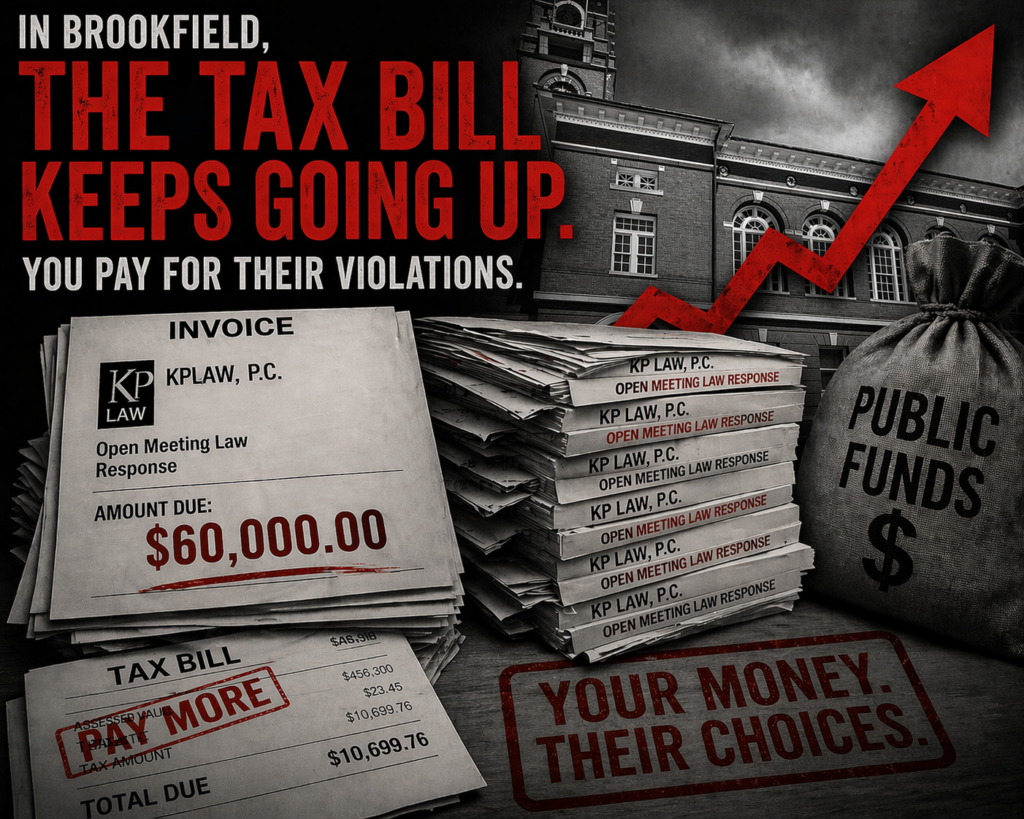
- The use of taxpayer funds to retain outside counsel, such as KP Law, to draft defensive responses
- Administrative time and resources spent addressing complaints rather than preventing them
- Potential financial penalties—up to $1,000 per violation for repeat offenses
And perhaps most troubling:
- A chilling effect on citizens who may think twice before speaking up
In Brookfield, the message has become clear: file a complaint, and you may become the next target.
What the Law Actually Requires
The Open Meeting Law exists for a simple reason: to prevent secrecy in government.
Its purpose, as recognized by Massachusetts courts, is “to eliminate much of the secrecy surrounding deliberations and decisions on which public policy is based.” Ghiglione v. School Committee of Southbridge, 376 Mass. 70, 72 (1978). In other words, the law exists to ensure that government business is conducted openly—so the public can observe, understand, and hold officials accountable.
This includes strict requirements for executive sessions. A public body must:
- State the specific purpose for entering executive session
- Cite the applicable exemption under the law
- Ensure that the reason is lawful and properly recorded
When a board enters executive session without stating a reason, it is not a gray area—it is a violation.
And in Brookfield, this is not a new issue. It is a repeated one.
A Refusal to Correct Course
Even when violations are formally reviewed by the Massachusetts Attorney General’s Office, the response from the Select Board is not reflection—it is resistance.
There is no acknowledgment.
No course correction.
No transparency with the public about the outcome.
Instead, determinations are often buried. The public is left uninformed about whether their government was found in violation of the very law designed to protect them.
Training Refused, Violations Repeated
One of the most basic remedies available is also the simplest: education.
The Attorney General’s Office provides free Open Meeting Law training for public officials. It is not burdensome. It is not optional in spirit, even if not strictly mandated in every instance—it is a fundamental responsibility of public service.
Yet in Brookfield, that training has been openly refused.
When asked to take advantage of the Attorney General’s free Open Meeting Law training, the former Chair of the Select Board dismissed the idea outright, stating, “I don’t have time to take the course.”
But conducting lawful, transparent public meetings is not a side task—it is a central function of the position.
Open meetings are not incidental to the job. They are the job.
And when an official declines to learn the rules governing that process, the consequences do not fall on the official—they fall on the public.
Transparency When Convenient, Silence When Not
Perhaps the most telling pattern is the Select Board’s inconsistent handling of complaints.
- When a complaint is perceived as minor or “technical,” it may be read aloud in full—accompanied by laughter, dismissiveness, and public ridicule.
- When a complaint raises serious legal concerns, the process becomes opaque.
A brief acknowledgment.
A quick vote.
No discussion.
No disclosure.
The public is told nothing.
This is not transparency. It is selective transparency—used as a tool, not a principle.
The Constitutional Issue
At its core, this is no longer just about procedural violations.
It is about rights.
The First Amendment guarantees citizens the right to petition their government for redress of grievances—without fear of retaliation.
When a citizen is publicly criticized, labeled, or targeted for filing a lawful complaint, the issue moves beyond Open Meeting Law compliance and into constitutional territory.
No resident should have to ask:
- “If I file this complaint, will I be attacked?”
- “Will I be labeled as harassing?”
That is not how accountable government works.
Who Pays the Price
Strip away the excuses, the deflection, and the rhetoric, and the outcome is simple:
The people of Brookfield pay.
They pay when a resident is singled out for doing exactly what the law allows.
They pay when taxpayer funds are used to defend avoidable violations through outside counsel like KP Law.
And they will pay if continued violations result in fines from the Massachusetts Attorney General’s Office.
Not the officials.
Not the decision-makers.
The public.
And until that changes, the cost of doing government wrong in Brookfield will continue to be passed—quietly, repeatedly, and unfairly—onto the very people the law was meant to protect.
A Final Thought
This is not complicated.
The Open Meeting Law is not an obstacle—it is a safeguard.
Citizens who invoke it are not adversaries—they are participants in democracy.
And a government that treats transparency as a threat is a government that has lost sight of its role.
In Brookfield, the law is clear.
The question is whether those in power will choose to follow it—or continue to fight the very people it was designed to protect.
In Brookfield, the cost of ignoring the law doesn’t fall on those who break it. It falls on the citizens—every time.
The Brookfield Examiner welcomes a response from the Select Board and will publish any official reply in full.