
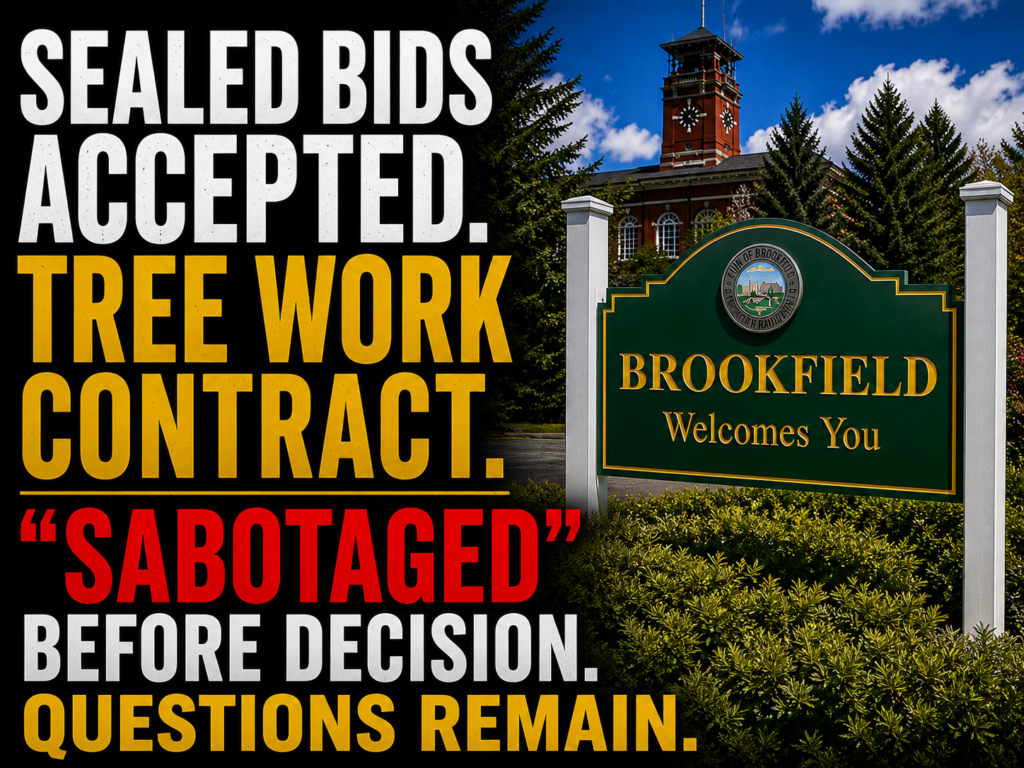
Tree project fallout raises questions about Brookfield’s procurement process
By Christopher Kelleher
BROOKFIELD, MA — A Brookfield tree removal project that was put out to competitive bid—and later cited as part of the town’s Tree Warden’s resignation—has raised questions about whether the town’s procurement process was effectively undermined after work was performed outside that process.
The project involved the removal of 15 hazardous trees at multiple locations across town, including municipal properties and roadside areas. Bid documents show that contractors were required to visit each site, assess conditions, and submit sealed bids along with supporting documentation such as insurance certifications, safety training credentials, and work qualifications.
The tree list itself identified specific locations throughout Brookfield—including Main Street, the Brookfield Cemetery, Rice Corner Road, Gay Road, and areas near the town water tower—requiring bidders to evaluate conditions across a wide geographic scope.
Six companies submitted bids, including Chaffee Tree Service, owned by the son of Select Board member Richard Chaffee. The company submitted a bid of $19,050, while Rusty’s Tree Service appeared to be the lowest bidder at $16,565.
Board delays decision—but work proceeds anyway
At an initial Select Board meeting, officials did not award the contract, indicating that the matter would be reviewed at a subsequent session.
Before that follow-up discussion occurred, however, two of the trees included in the bid were cut down.
During a later public meeting, Select Board member Richard Chaffee said he had performed the work himself, explaining that he went onto town property with a chainsaw and hoist, removed the trees, and cleaned up the site.
He also said his actions were intended to “save the town money.”
Safety questions raised
During the discussion, Select Board member Beth Coughlin said that town employees are typically required to work in pairs when operating chainsaws, citing standard safety practices.
Board members also raised questions about potential liability if work is performed outside normal procedures—particularly if an incident were to occur when a person is working alone.
Impact on a completed bidding process
By the time the trees were removed, contractors had already visited multiple sites, evaluated hazardous trees, prepared documentation and certifications, and submitted sealed bids in good faith.
Under Massachusetts General Laws Chapter 30B, municipalities are required to conduct procurement in a manner that promotes full and fair competition.
Public procurement processes are designed not only to protect taxpayers, but also to ensure that businesses competing for municipal work are treated fairly.
When part of a project is performed after bids are submitted and opened—but before a contract is awarded, the scope of work changes, submitted pricing may no longer reflect the project, and the competitive process can be disrupted.
During the meeting, the situation was described as having effectively “sabotaged” the contract, referring to the impact of removing part of the work after bids had already been completed.
Conflict and contradiction raised
The issue is further complicated by the presence of Select Board member Richard Chaffee’s son among the bidders.
During the meeting, Chaffee acknowledged that his son had submitted a bid and was not the successful bidder, stating:
“It’s also true that my son lost the bid, but it’s also true that I want the tree work to go to the individual that Mr. Tucker [the Tree Warden] wants to hire.”
However, his decision to perform part of the work himself—after bids had been opened—raised questions about whether those actions aligned with that stated position.
Chaffee went on to describe the contract as having become “functionally… sabotage to a certain extent” and a “defective RFP,” attributing that assessment to the involvement of National Grid, which he said would remove part of the work.
He also stated that he had spoken with National Grid regarding the removal of two trees. Public records reviewed by the Brookfield Examiner, however, do not reflect an agreement authorizing that work.
Water department concerns
The incident also reportedly extended onto water department property, raising concerns about potential impacts to municipal infrastructure.
While no damage has been publicly confirmed, the involvement of multiple municipal properties—including infrastructure-related land—adds another layer of concern regarding how the work was performed and whether appropriate coordination occurred.
Connection to Tree Warden resignation
The handling of the project is not occurring in isolation. It overlaps directly with the circumstances surrounding the resignation of Brookfield’s Tree Warden, Denis Tucker.
In his February 2025 resignation letter, Tucker stated that his decision was driven by what he described as “ongoing disregard for legal and safety protocols surrounding tree work, specifically due to the actions of Selectman Chaffee.”
He warned that essential safety principles were being ignored, writing that such conditions were “putting both employees and the public at unnecessary risk.”
Tucker also raised concerns about the use of untrained personnel for hazardous work and what he described as a shift away from established arboricultural standards in favor of convenience and perceived efficiency.
The bidding process described in this case—including work performed outside that process, the use of non-contracted labor, and questions raised about safety practices—occurred during the same timeframe and involved the same subject matter outlined in Tucker’s resignation.
A question of trust—and cost
Beyond the immediate project, the situation raises a broader question for Brookfield: whether contractors will continue to bid on town work.
Preparing a bid for a project of this scale typically requires site visits, risk assessment, documentation and certification, and a significant investment of time and labor. If that work can be rendered moot after submission, some contractors may choose not to participate in future bids.
When participation declines, competition can decrease and costs can rise. Public procurement laws are designed to prevent that outcome by promoting a fair and predictable process intended to deliver the best value for taxpayers.
Unanswered questions
Several questions remain unresolved, including why the work was performed before the board completed its review and how the decision to proceed outside the bidding process was made.
During the meeting, board members indicated that the work had not been authorized.
It also remains unclear how removing part of the project may affect the submitted bids, and what steps, if any, the town will take to ensure future bidding processes are followed.
A broader implication
At its core, the issue is not just about two trees.
It is about whether Brookfield’s bidding process—designed to ensure fairness, transparency, and value for taxpayers—can be relied upon by the businesses asked to participate in it.
For contractors weighing whether to bid again, the answer may come next time Brookfield puts work out to market.
Richard Chaffee did not respond to several requests for comment.