
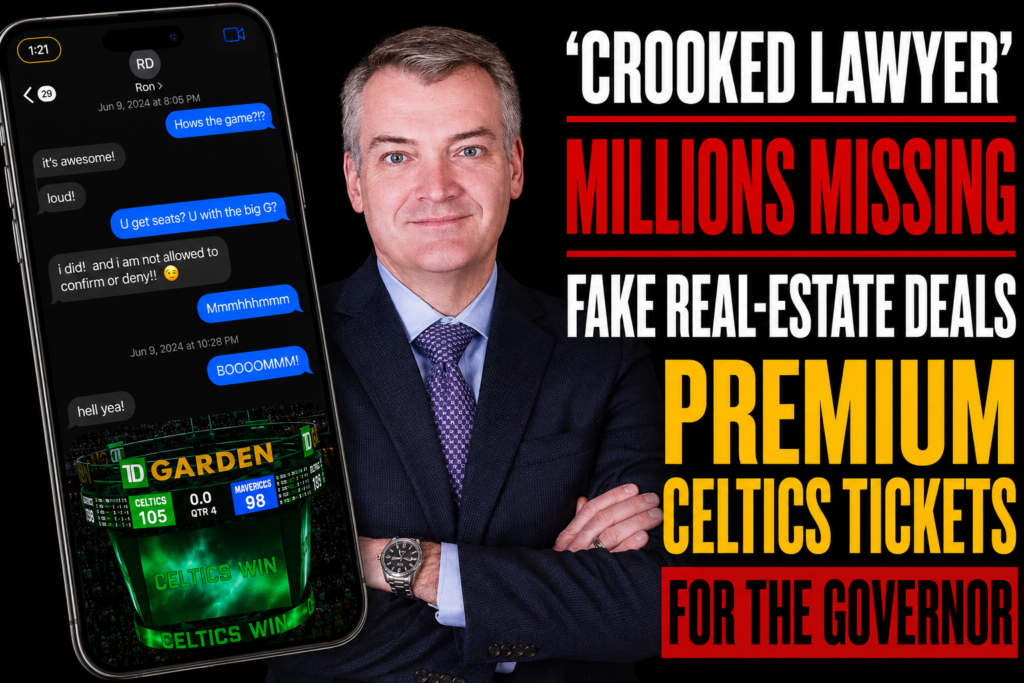
‘CROOKED LAWYER’: MILLIONS MISSING, FAKE REAL-ESTATE DEALS — AND PREMIUM CELTICS TICKETS FOR THE GOVERNOR
Former clients describe millions of dollars flowing into the control of attorney Ronald W. Dunbar Jr. through alleged bogus property deals, high-interest loans, supposed settlements and client funds — while one longtime client says he was even asked to pull favors for premium NBA Finals tickets for an outing with Rhode Island’s governor. Now, after Dunbar’s death, one question hangs over it all: Where did the money go?
By Christopher Kelleher
When Ronald W. Dunbar Jr. died in July, the Massachusetts attorney left behind more than unfinished cases and clients suddenly without a lawyer.
He left behind a financial maze.
In the weeks since Dunbar’s death, former clients, lenders and business associates have begun comparing records, examining court files and contacting people Dunbar claimed were involved in transactions. What has emerged is a growing collection of allegations involving millions of dollars and multiple ways in which money allegedly flowed into Dunbar’s control.
There are real-estate transactions former clients now say never existed. There are allegations that the same property was pitched to multiple investors. There are hundreds of thousands of dollars placed into Dunbar’s attorney trust account as supposed “proof of funds.” There are settlement proceeds clients say they never received. There is money clients say they gave Dunbar specifically to pay judgments or negotiated debts — only to discover the other side allegedly never got paid.
There are enormous short-term loans carrying interest rates as high as 10 and 12 percent per month. There are loans secured by anticipated proceeds belonging to Dunbar’s personal-injury clients.
And now there are bank records showing $215,000 deposited by one Dunbar client into the firm’s IOLTA account — followed weeks later by $60,000 being wired from that account to a contractor who says Dunbar owed the money for construction work performed on Dunbar’s own house.
The numbers keep getting bigger.
The Brookfield Examiner’s examination of lawsuits, financial records and accounts from former clients has now identified approximately $10 million connected to claimed losses and disputed financial transactions surrounding Dunbar.
It is money coming from seemingly every direction.
And increasingly, the people trying to reconstruct Dunbar’s financial affairs are asking the same question:
Where did it all go?
A Lawyer His Client Trusted
Christopher Tenaglia, president of High Pace Construction, says Dunbar wasn’t simply a lawyer he hired for a single transaction.
He trusted him for more than a decade.
That relationship is critical to understanding what happened next. Tenaglia says that when Dunbar described a real-estate transaction, he believed there was a transaction. When Dunbar told him hundreds of thousands of dollars needed to be placed into his IOLTA account, he put the money there. When Dunbar told him a legal matter had been resolved, Tenaglia believed it had been resolved.
Dunbar was his lawyer.
Only after Dunbar died did Tenaglia begin checking those representations for himself.
What he says he discovered has caused him to question nearly everything.
$326,430 for a Property Dunbar Didn’t Own
One of the most striking allegations involves 28 Pelham Street in Newport, Rhode Island.
Tenaglia says Dunbar presented him with what appeared to be an extraordinary real-estate opportunity. According to Tenaglia, Dunbar represented that the property could be purchased for approximately $2 million and that IYRS School of Technology would ultimately acquire it. High Pace Construction would then receive substantial construction work associated with the property.
It wasn’t presented as some vague possibility. Messages provided to The Examiner show Dunbar discussing people involved in the transaction, approvals, signatures, a purchase-and-sale agreement and an eventual closing.
Dunbar already held $26,430 belonging to Tenaglia. Tenaglia says Dunbar told him another $300,000 had to be placed into his IOLTA account as proof of funds.
Tenaglia wired $180,000 on March 25, 2026, and another $120,000 the following day.
Dunbar then sent Tenaglia an image of his IOLTA account showing the funds.
Total: $326,430.
Tenaglia waited for the deal to close.
It never did.
After Dunbar’s death, Tenaglia began contacting people supposedly connected to the transaction and says he discovered that the elaborate deal his lawyer had spent months describing apparently didn’t exist.
“There was a wildly made up story with details that made it sound like there was a real deal but using real peoples names,” Tenaglia told The Examiner.
The Same Property — Again and Again
Tenaglia apparently wasn’t the only person being presented with a transaction involving 28 Pelham Street.
GoLocalProv has reported identifying three alleged victims connected with purported Dunbar transactions involving the property, with alleged losses exceeding $1 million.
Molly Kirby told GoLocal that Dunbar Law’s actual relationship with the building was that the firm rented a single office there. She said neither Dunbar nor Dunbar Law was involved in the property’s eventual sale.
Tenaglia says another alleged victim contacted him after Dunbar’s death with what he described as the same purported purchase-and-sale agreement involving the same property, similar deposit terms and another arrangement involving money being placed into Dunbar’s IOLTA account.
The allegations go far beyond a real-estate deal that simply fell apart.
Multiple people say they were presented with purported transactions involving the same property — a property Dunbar didn’t own and apparently had no authority to sell.
Another Client. Another $350,000. The Same Property.
A verified lawsuit filed by another former Dunbar client describes an eerily similar allegation involving the same Newport property — 28 Pelham Street.
Kevin Greene alleges in Suffolk Superior Court that he entrusted $350,000 to Dunbar for a proposed real-estate transaction involving the property.
According to Greene’s verified complaint, Dunbar provided him with a purportedly executed agreement bearing the signature of Molly Kirby, a representative of the company involved in the proposed purchase.
After Dunbar’s death, Greene says he contacted Kirby directly. According to the complaint, Kirby told him she had not signed the document, the property was already under agreement with another party, and Dunbar had no involvement in the transaction.
Greene’s lawsuit alleges the document was “not genuine” and that Dunbar used it to induce him to transfer $350,000 into Dunbar Law’s account.
The similarities between Greene’s allegations and Tenaglia’s account are striking: a trusted attorney, a supposedly lucrative property transaction, documents making the deal appear legitimate and hundreds of thousands of dollars transferred into Dunbar’s control.
Then Came Another $300,000
Tenaglia says 28 Pelham wasn’t the only purported real-estate transaction Dunbar brought him.
There was another involving property in Somerville.
Again, Dunbar needed money.
This time, $300,000.
Tenaglia initially demonstrated that he had the funds available in his own account. According to messages provided to The Examiner, Dunbar told him that wasn’t sufficient.
“I have to show her proof of funds in my trust account so she’ll take it off the market and only deal with me for the next few weeks,” Dunbar wrote.
Dunbar sent wire instructions, and Tenaglia transferred the money.
Tenaglia now says that deal wasn’t real either.
This time he aggressively demanded his money back, and Dunbar ultimately returned the approximately $300,000 through two wire transfers, Tenaglia says.
But the transaction raises another question in a story increasingly filled with them: Why did $300,000 need to leave the client’s bank account and enter his attorney’s trust account for a real-estate transaction Tenaglia says didn’t exist?
$370,000 for a Deal Tenaglia Says Didn’t Exist
Real estate wasn’t the only reason Tenaglia says Dunbar wanted large amounts of money under his control.
In another pending legal matter, Tenaglia says Dunbar represented that approximately $370,000 was needed in his IOLTA account in connection with a purported arrangement to resolve the case.
Tenaglia believed his attorney.
A contemporaneous text message documents exactly what Tenaglia understood Dunbar had represented. When Tenaglia later demanded approximately $372,000 back, he wrote:
“Per our conversation, I fully understand the implications of returning the $372,000 to my account and the deal with Lindsey to get the case dismissed will be off. I need all of my money back on Monday.”
Dunbar responded that he needed to reconcile the account because money had also been wired back to Tenaglia’s father.
Tenaglia subsequently retained another attorney. According to Tenaglia, that attorney contacted opposing counsel and learned there was no such deal and opposing counsel had not heard from Dunbar in months.
It is another allegation with the same basic architecture: Dunbar allegedly represented that something was happening, a substantial amount of client money had to be placed under his control to make it happen, and Tenaglia says he later learned the arrangement his attorney described didn’t exist.
Then Arthur Started Looking for His Money
Christopher Tenaglia isn’t the only member of his family now trying to determine what happened to money entrusted to Dunbar.
His father, Arthur Tenaglia, says his own dealings with Dunbar involve hundreds of thousands of dollars from several separate matters — money he says he was entitled to receive or money he gave Dunbar for specific purposes that apparently never reached its intended destination.
One involved a $1.1 million real-estate transaction.
Arthur Tenaglia says Dunbar handled the closing and that after the transaction was completed, Tenaglia was supposed to receive approximately $239,000 in net proceeds.
The closing happened.
Arthur says the $239,000 never arrived.
Then there was a loan Dunbar was supposedly negotiating on Arthur’s behalf. According to Arthur, Dunbar told him the lender had agreed to resolve the outstanding obligation for $129,000.
Arthur says he wired the $129,000 into Dunbar’s IOLTA account so his attorney could pay the negotiated amount and resolve the debt.
Now Arthur says he is fighting the matter in court, with the lender threatening to call the note and foreclose on the property.
Arthur’s position is simple: he already paid the money.
According to Arthur, attorneys representing the lender say they hadn’t spoken with Dunbar in months.
Arthur says the $129,000 he gave Dunbar to resolve the debt never reached the lender.
A $47,000 Settlement — and Arthur Says He Got Nothing
There was more.
Arthur says Dunbar represented him in a case involving damage to a driveway at a property in Hull Ma.
According to Arthur, the insurance company settled the claim for approximately $47,000 and issued a check.
Arthur says he hasn’t seen a penny of it.
He describes two additional cases that he says produced approximately $186,000 in combined settlements.
Again, Arthur says the money never reached him.
Add those amounts together — $239,000 in real-estate proceeds, $129,000 Arthur says he gave Dunbar to satisfy a loan, $47,000 from the Hull matter and approximately $186,000 from two other settlements — and Arthur is questioning approximately $601,000 across those matters alone.
These aren’t all allegations that Dunbar simply failed to win a case or obtain a result his client wanted.
Arthur says the real-estate closing actually happened. The insurance company actually settled the Hull claim. The other cases actually settled. And he actually wired $129,000 to Dunbar to satisfy what his lawyer told him was a negotiated obligation.
His question now is what happened to the money.
‘We Already Paid This’
Arthur isn’t the only former Dunbar client describing that problem.
A Rhode Island client who asked not to be identified because of continuing litigation told The Brookfield Examiner that Dunbar represented that an outstanding claim could be settled for approximately $220,000.
The client says Dunbar told them what was needed to resolve the case.
They provided the money.
They believed their obligation had been paid.
Now, after Dunbar’s death, the client says they have discovered that the $220,000 was never paid to the other side.
The client says the situation has left them facing the same obligation they believed they had already paid Dunbar to resolve.
Their frustration is obvious: they don’t have another $220,000 sitting around to pay the obligation a second time.
From their perspective, they already paid it.
They gave the money to their lawyer.
The other side says it never got there.
‘How Many Times Do I Have to Pay the Same Judgment?’
Another former Dunbar client, who also asked not to be identified because of continuing litigation, described an even smaller version of the same alleged pattern.
The client says Dunbar told him that he had lost a case and would need approximately $20,000 to satisfy the judgment.
The client says he provided the money to Dunbar.
He believed the judgment had been paid.
Now, he says, he is being hauled back into court because the other side says the judgment remains outstanding.
The client says he has proof showing that he gave the approximately $20,000 to Dunbar specifically to satisfy that obligation.
“How many times do I have to pay a judgment?” the client told The Examiner. “I already paid it. I gave the money to my lawyer. I have proof that I gave it to him, and now I’m being brought into court because the other side says they never got paid.”
The client put his view of what happened even more directly:
“My lawyer just took the money and ran.”
This Reporter Watched Another Fight Over Missing Money
And The Examiner has witnessed a version of the problem firsthand.
This reporter was at Worcester Superior Court for an unrelated matter when another case involving Dunbar Law was called.
An attorney on the opposing side was seeking sanctions against Dunbar Law and complaining to the judge that a judgment exceeding $50,000 had been entered but remained unpaid.
The attorney told the court that payment had been requested and that attempts to obtain an explanation for why the judgment remained unpaid had produced no meaningful answers.
Jaffar Shiek appeared for Dunbar Law.
During the hearing, the judge suggested that the attorneys go into the hallway and talk in an effort to resolve the dispute.
They did.
The case was later called a second time.
The opposing attorney returned to the courtroom visibly frustrated and told the judge, in substance, that the conversation had only made him more frustrated than before. He said he still had no real answer about why the judgment had not been paid and continued pressing the court for sanctions.
The attorney complained about the time he had been forced to spend preparing the sanctions request and coming to court simply to obtain payment of a judgment that had already been entered.
The judge took the matter under advisement.
The amount involved was smaller than many of the transactions now surrounding Dunbar.
But that is precisely the point.
The questions about money aren’t limited to $300,000 real-estate deposits or multimillion-dollar loans.
Sometimes it is $220,000.
Sometimes $129,000.
Sometimes $50,000.
Sometimes $47,000.
Sometimes $20,000.
Different amounts. Different cases. The same question: Where is the money?
$215,000 Came In. Then $60,000 Went to High Pace
Then came something different: the bank records themselves.
An August 31 demand letter from an attorney representing former Dunbar client Charles Grant says Grant wired $215,000 into Dunbar Law’s IOLTA account on July 6, 2026, strictly for the limited purpose of completing a real-estate transaction.
The bank records accompanying the demand letter document two incoming wires that day: $148,000 and $67,000.
Together: exactly $215,000.
Then money left the account.
On July 20, Dunbar Law’s IOLTA wired $40,000 to High Pace Construction.
On July 27, another $20,000 was wired from the same account to High Pace.
Total: $60,000.
Grant’s attorney alleges those transfers are traceable to Grant’s entrusted funds and were made without his knowledge or authorization. The attorney says Grant never authorized his money to be used for operating expenses, personal expenses or payments to unrelated third parties.
But Christopher Tenaglia says he knew nothing about Charles Grant or the source of the money.
Tenaglia says Dunbar owed High Pace $60,000 for construction work the company had performed on Dunbar’s own house.
As far as Tenaglia was concerned, Dunbar was simply paying his construction bill.
Now Grant’s attorney is demanding the money back.
The demand letter instructs High Pace to preserve records concerning the payments, refrain from disposing of the $60,000 or identifiable proceeds, and return the entire amount by 5 p.m. September 8. The letter threatens litigation seeking restitution, unjust enrichment, conversion, tracing and other remedies if the money isn’t returned.
In perhaps the clearest illustration yet of the financial wreckage Dunbar left behind, two men who both say they were victimized by the same lawyer are now being pitted against each other over the same $60,000.
It is a pattern The Brookfield Examiner has encountered before.
In the multimillion-dollar Rhode Island litigation surrounding Dunbar, people who say they were themselves Dunbar’s victims have nevertheless found themselves named in litigation and fighting over money, collateral and financial obligations arising from transactions Dunbar arranged.
Now it is happening again.
Grant’s attorney says the $60,000 belonged to Grant.
Tenaglia says High Pace legitimately earned the $60,000 for construction work performed on Dunbar’s house and had no knowledge that the payments allegedly involved another client’s entrusted funds.
If Grant’s attorney’s tracing allegation is correct, the obvious question becomes:
Was money entrusted to Dunbar by one client for a real-estate transaction being used to pay Dunbar’s own personal construction bill?
And now the contractor who says it performed legitimate work, was owed the money and accepted payment from its customer is being told to give the $60,000 back.
Two alleged victims. One $60,000 pot of money. And the lawyer both trusted is no longer here to explain what he did with it.
The timing of the second payment is striking for another reason.
The $20,000 was wired on July 27.
Dunbar died the following day.
Loans Against His Own Clients
Then there were Dunbar’s personal-injury clients.
Rhode Island litigation describes loans involving anticipated proceeds from personal-injury cases being handled by Dunbar.
The transactions eventually pulled Dunbar’s own clients into litigation after his death.
The lenders contend their money was secured by anticipated proceeds from those cases. The clients say they were Dunbar’s victims too.
People who hired Dunbar to represent them were suddenly entangled in multimillion-dollar litigation arising from financial transactions arranged by their own lawyer.
$4.4 Million — and Interest as High as 144 Percent
The scale becomes even larger in Rhode Island litigation involving Dunbar, Pastor Delman Coates and Five Five Plus LLC, the company connected with The Orchard development in West Warwick.
The litigation involves approximately $4.4 million in claimed obligations connected with Dunbar and the transactions at issue.
And the terms documented in those records are staggering.
Some loans carried interest of 10 percent per month.
Others carried 12 percent per month — 144 percent on a simple annual basis.
These weren’t necessarily loans designed to sit on the books for years.
In an email contained in the records, Dunbar himself described some transactions as:
“60 day deals at the 10% per month.”
Sixty days.
The documents paint a picture of enormous amounts of money being borrowed at extraordinary rates with extremely short repayment windows.
At the same time, former clients now say hundreds of thousands of dollars were flowing into Dunbar’s control through real-estate transactions, settlement payments and purported legal arrangements they later discovered weren’t what Dunbar had represented them to be.
Big Money. Small Money. Same Question.
By now, the allegations surrounding Dunbar span almost every size and type of transaction.
There are six-figure real-estate deposits. Settlement proceeds. Money supposedly needed to pay judgments. Funds allegedly required to negotiate down debts. Personal-injury proceeds pledged as collateral. High-interest loans involving millions of dollars.
And now there is a former client’s attorney alleging that money entrusted to Dunbar for one client’s real-estate transaction was transferred to a contractor who says Dunbar was paying a bill for work performed on Dunbar’s own house.
Sometimes the amount was $350,000.
Sometimes $220,000.
Sometimes $129,000.
Sometimes $47,000.
Sometimes approximately $20,000.
But former clients and opposing attorneys keep describing variations of the same problem:
Money was supposed to go somewhere. It didn’t get there. And now everybody wants to know what Dunbar did with it.
While the Money Moved, Clients Say Their Cases Suffered
Another complaint is emerging from Dunbar’s former clients: while enormous amounts of money were moving through his financial dealings, they say the legal practice they were paying him to operate was falling apart.
Former clients have described emails that went unanswered, work pushed until the last minute, repeated requests for additional time, missed obligations and cases they say weren’t receiving the attention they expected from their attorney.
One former client, who asked not to be identified because he remains involved in active litigation previously handled by Dunbar, said he repeatedly found himself researching his own case and questioning why his attorney wasn’t pursuing issues he believed were important.
“How can Ron be my attorney and really be advocating for my case? He doesn’t respond to my emails. Everything is last minute. We’re always asking for more time, and he’s not doing anything,” the former client said. “I would use AI to look stuff up and I’m asking him, ‘Ron, why didn’t we do this? What the heck, man?’”
After Dunbar’s death, the former client says he began discovering the consequences.
“We’re missing obligations. We’re missing deadlines. And now I have this horribly written complaint and I have a real case that is now just total garbage,” the client said.
His conclusion about what had consumed Dunbar’s attention was even harsher.
“He was too busy running his scams. He wasn’t practicing law. He was running a scam empire.”
Malpractice claims are now among the claims emerging from former Dunbar clients as they examine the legal and financial affairs he left behind.
And Somehow, There Were Premium Celtics Tickets
Against millions of dollars, alleged bogus transactions and lawsuits, what happened with a pair of basketball tickets might initially sound insignificant.
It isn’t.
Tenaglia says Dunbar asked him to obtain difficult-to-get premium Celtics Boardroom tickets for Game 2 of the 2024 NBA Finals between the Boston Celtics and Dallas Mavericks at TD Garden on June 9, 2024.
Dunbar told him the tickets were for an outing with Rhode Island Gov. Dan McKee, Tenaglia says.
Tenaglia says he had to use personal connections and call in favors to secure them for his attorney.
He did.
The surviving messages establish that Dunbar attended the game.
During the game, Tenaglia texted asking how it was going. Dunbar replied that it was “awesome” and “loud.”
Then Tenaglia asked:
“U get seats? U with the big G?”
Dunbar responded:
“i did! and i am not allowed to confirm or deny! ”
Tenaglia says “the big G” referred to McKee, whom Dunbar had told him he planned to take to the game.
Dunbar later sent Tenaglia a photograph from inside TD Garden.
The Examiner has been unable to find independent evidence establishing that McKee attended the June 9 game with Dunbar. The newspaper contacted the governor’s office seeking to determine whether McKee attended the game, planned to attend with Dunbar or knew about the proposed outing.
No response was received before publication.
For Tenaglia, the episode has become one more representation from his longtime attorney that he is now going back and checking.
Dunbar said he needed premium NBA Finals tickets for an outing with Rhode Island’s governor.
Tenaglia trusted his lawyer.
So he pulled the favors and got them.
$10 Million — Where Did It Go?
And that brings everything back to the money.
The Brookfield Examiner’s examination of court records, financial documents and accounts from former clients has now identified approximately $10 million connected to the growing collection of claimed losses and disputed transactions surrounding Ronald Dunbar.
There was money for purported real-estate deals. Money deposited as proof of funds. Settlement proceeds. Money supposedly provided to pay judgments. Money intended to satisfy negotiated debts. Money borrowed against anticipated personal-injury proceeds. Money borrowed against other assets. Money obtained through extraordinarily expensive short-term loans.
And now there are bank records documenting $215,000 entering Dunbar’s IOLTA from one client, followed by $60,000 leaving that account for a contractor who says Dunbar owed the money for work on his house — transfers the first client’s attorney alleges involved his client’s money.
Money kept coming in.
But where was it going?
That is the question former clients are increasingly unable to answer.
People who knew Dunbar have not described a man living an obviously extravagant multimillion-dollar lifestyle. There was no outward display of wealth that readily explains the enormous sums now appearing in lawsuits, bank records and claims.
Instead, even as enormous amounts of money were moving through Dunbar’s financial affairs, the records show him borrowing still more.
And some of that borrowing came at astonishing rates.
Dunbar himself described certain transactions as “60 day deals at the 10% per month.” Other documented loans carried interest of 12 percent per month — 144 percent on a simple annual basis.
Huge interest.
Huge principal.
Very short due dates.
Then Dunbar died.
The Closing Was the Next Day
The timing of Dunbar’s death has now added another dimension to the mystery surrounding his financial affairs.
Tenaglia’s contemporaneous messages show Dunbar continuing to represent that the purported 28 Pelham Street transaction was finally approaching its closing.
After months of explanations and assurances, Dunbar gave his client a date:
“closing is on the 29th.”
Dunbar died July 28, 2026.
The purported closing was the next day.
Tenaglia had $326,430 tied to a transaction his attorney had been telling him was about to close. After Dunbar died and Tenaglia began contacting the people supposedly involved, he says he discovered there was no transaction waiting to close.
And now that timing has collided with the unanswered question surrounding millions of dollars and Dunbar’s extraordinary short-term borrowing.
Together, those circumstances are fueling an extraordinary conspiracy theory among some of Dunbar’s former clients: that Ronald Dunbar faked his death and disappeared.
The theory is being fueled by three things.
The first is the money. Approximately $10 million has now surfaced across the claimed losses and disputed transactions examined by The Brookfield Examiner, while former clients continue asking where all of that money ultimately went.
The second is the borrowing. Dunbar was taking enormously expensive short-term loans, including transactions he himself described as 60-day deals at 10 percent interest per month and other documented loans carrying interest rates as high as 12 percent per month.
Those loans had due dates.
And the third is the timing.
Tenaglia had $326,430 tied to a purported real-estate transaction that Dunbar told him was finally going to close July 29.
Dunbar died July 28.
One day.
Those circumstances have become impossible to separate from the rumor now circulating among some of the same former clients who say they discovered after Dunbar’s death that real-estate transactions weren’t real, cases hadn’t been resolved, purported agreements weren’t genuine, settlement proceeds hadn’t reached them and money they gave their attorney to pay other people apparently never got there.
One former client summed up the sentiment this way:
“Ron was a con man. Faking his death? I wouldn’t put it outside his wheelhouse.”
Maybe the timing is coincidence. Maybe the short-term borrowing has another explanation. Maybe the money trail will eventually provide answers.
But right now, the conspiracy theory is being fed by a financial mystery that continues to grow with almost every former client who comes forward.
A purported real-estate transaction involving more than $326,000.
Another alleged bogus transaction involving $350,000.
Another $300,000 transferred into Dunbar’s trust account.
Approximately $370,000 tied to a supposed legal arrangement Tenaglia says didn’t exist.
Arthur Tenaglia questioning approximately $601,000 from a closing, a loan payoff and settlements.
A Rhode Island client saying $220,000 intended to settle a claim never reached the other side.
Another client saying approximately $20,000 intended to satisfy a judgment never got there.
An attorney standing in Worcester Superior Court demanding answers about another unpaid judgment exceeding $50,000.
A $215,000 client deposit into Dunbar Law’s IOLTA, followed by $60,000 in payments to a contractor who says Dunbar owed the money for construction work on Dunbar’s own house.
Personal-injury proceeds pledged in loans.
Approximately $4.4 million in obligations at the center of the Rhode Island litigation.
And short-term borrowing carrying interest rates reaching 144 percent on a simple annual basis.
All told, The Brookfield Examiner’s examination has now reached approximately $10 million.
And the question that keeps getting louder isn’t a conspiracy theory at all.
Where did all the money go?
Disclosure: Ronald W. Dunbar Jr. previously represented The Brookfield Examiner editor Christopher Kelleher in unrelated civil litigation. That litigation did not involve the loans or real-estate transactions discussed in this article.