
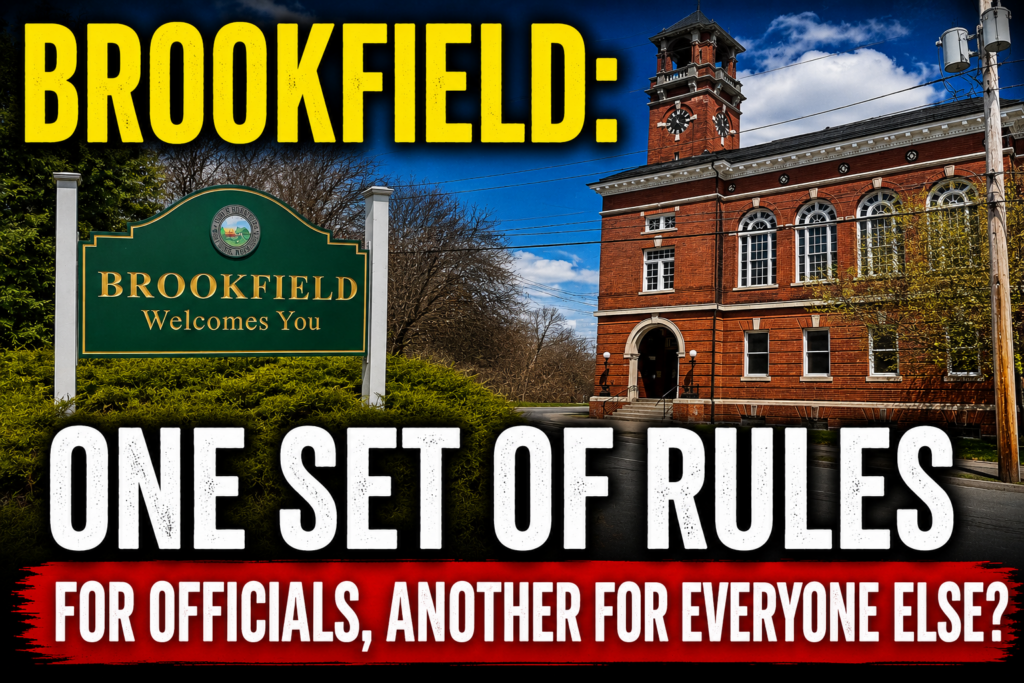
Editorial: One Set of Rules for Officials, Another for Everyone Else?
By Christopher Kelleher
This editorial is the third part of the Brookfield Examiner’s ongoing coverage surrounding the controversial removal of two trees from town property by Select Board member Richard Chaffee.
As previously reported, the incident resulted in the resignation of Brookfield’s Tree Warden following public controversy over whether proper municipal procedures, bidding practices, and tree removal policies were bypassed. Questions have also been raised regarding the removal of wood from the property and whether ordinary residents would have been treated differently under similar circumstances.
This editorial examines the broader issues raised by the controversy: accountability, equal enforcement of rules, public trust, and whether elected officials are being held to the same standards expected of ordinary citizens.
Brookfield residents should be asking themselves a very simple question:
What would happen if one of us did this?
What if an ordinary citizen walked onto town property, cut down two trees without authorization, removed the wood, and interfered with an active municipal bid process?
Would that citizen simply walk away?
Or would they be facing outrage, legal consequences, demands for accountability, and possibly even criminal investigation?
Because that is the question now hanging over the Town of Brookfield.
As previously reported, sealed bids had already been opened regarding the tree work. According to statements made during public meetings, it had become apparent that Select Board member Richard Chaffee’s son was not going to receive the contract.
Then, before the matter was formally revisited by the board at its next meeting, Richard Chaffee took it upon himself to go onto town property and cut two of the trees down himself.
Not through a vote.
Not through a formal authorization.
Not through the Tree Warden.
Not through the established process.
Unilaterally.
Even more troubling, the wood was removed. That wood belonged to the taxpayers of Brookfield, and in a rural community like Brookfield, wood has real value.
Anyone in rural Massachusetts understands this. Many residents heat their homes with wood. Some use outdoor wood furnaces all winter long. Firewood is not worthless property. It has real value, whether that value is measured in hundreds of dollars or a single dollar.
It still belonged to the town.
During the public discussion, Mr. Chaffee reportedly stated that when the town removes trees, the wood is often left behind for residents to take and use.
But that only raises more questions about what happened here.
If the town’s normal practice is to leave the wood for the benefit of residents, then why was this situation handled differently?
Why was the wood allegedly taken by the same elected official who unilaterally cut the trees down?
Many Brookfield residents heat their homes with wood. For some families, firewood carries real financial value. Under the practice described publicly by Mr. Chaffee himself, that wood would ordinarily remain available to the public.
Instead, the public property was allegedly removed.
Permission matters.
Process matters.
Public property matters.
And the question remains unanswered: why was an elected official allowed to take public property without consequence?
No public censure.
No meaningful accountability.
No referral.
No serious investigation.
Nothing.
Meanwhile, the Town lost its Tree Warden — a volunteer with deep knowledge of tree law, procedure, and municipal compliance.
A volunteer who cost taxpayers nothing.
Watching the public meeting was revealing. The former Tree Warden answered questions directly, cited procedures, and appeared thoroughly familiar with the legal framework surrounding tree removals. Yet throughout the discussion, interruptions and pressure repeatedly redirected the conversation.
Many residents have seen this pattern before.
Anytime someone attempts to challenge Richard Chaffee publicly, the response often follows the same formula: dominate the conversation, interrupt repeatedly, and bulldoze an alternate version of events into the record through sheer force of personality.
This newspaper has seen it before.
Others in town government have seen it before.
And according to prior public meetings, even members of boards and commissions have experienced it firsthand.
But this controversy goes beyond personality or political style.
This controversy strikes at the heart of whether Brookfield operates under one set of rules for ordinary residents and another set for politically connected officials.
Because ordinary residents do not get to sabotage bid processes.
Ordinary residents do not get to bypass municipal procedure because they believe they “know better.”
Ordinary residents do not get to enter public property, perform hazardous tree work alone, remove town property, and then explain it away afterward.
And ordinary residents certainly do not get excused simply because they claim:
“I’ve been doing this for years.”
That excuse surfaced again during this controversy.
But experience does not place anyone above the law.
In fact, some of the most catastrophic accidents occur when experienced individuals become overly comfortable, overly confident, and stop respecting procedure itself.
Tree work is dangerous.
Chainsaw work is dangerous.
The Town itself reportedly maintains safety policies requiring at least two people present during chainsaw operations so that someone can summon emergency assistance if necessary.
Yet the work was allegedly performed alone anyway.
Again: would an ordinary town employee be allowed to ignore safety policy this way?
Would an ordinary citizen?
Or is this another example of rules becoming optional depending on who you are?
This is also not the first time this explanation has surfaced in controversy involving Mr. Chaffee.
For transparency, this reporter was the Conservation Commission chair involved in a prior dispute concerning the alleged use of state land near a protected wetland area for loading and unloading dirt, sand, and other material connected to Mr. Chaffee’s private business activities.
During that matter, a Conservation Commission member publicly stated that they had spoken with the Massachusetts Department of Environmental Protection and had been informed that a Request for Determination of Applicability (RDA) would be required for the activity in question.
Yet according to statements made during the public discussion, Mr. Chaffee indicated that he had been using the area in that manner for many years — reportedly as long as 25 years — without obtaining permits or going through the Conservation Commission process.
That raises another troubling question:
Why is an elected official allegedly able to use state land for his private business that was adjacent to a protected wetland area for decades without permits, without filings, and without oversight, while ordinary residents are expected to navigate formal environmental review procedures, engineering requirements, filings, hearings, and compliance orders?
And when concerns were finally raised publicly, the discussion reportedly shifted away from the conduct itself and toward criticism of the chair who brought the issue forward, including calls by Mr. Chaffee for that chair’s removal.
Mr. Chaffee also reportedly stated during the controversy that he would no longer use the area in question.
But the broader issue remains.
What message does this send to the public?
That if a politically connected official engages in questionable conduct long enough, the conduct itself becomes acceptable?
That if someone finally raises concerns, the person who reported the issue becomes the real problem?
Because many residents may now see a troubling parallel between what happened at the Conservation Commission and what later happened with the Town’s Tree Warden.
A concern was raised.
Procedure was defended.
Questions were asked.
And ultimately, the individual raising those concerns was pushed out.
That is not how accountability is supposed to work in local government.
Longevity is not the same thing as legality.
And familiarity does not eliminate accountability.
Brookfield residents should not have to wonder whether enforcement depends on your last name, your political influence, or your position in town government.
Public trust erodes when residents begin believing that ordinary people would face consequences for conduct that elected officials simply explain away.
The loss of the Tree Warden should concern everyone.
Because when knowledgeable volunteers walk away from town service after controversy like this, the damage extends far beyond two trees.
The real question now is not whether the trees should have come down.
The real question is whether Brookfield still believes that process, accountability, and equal treatment under the rules apply equally to everyone.